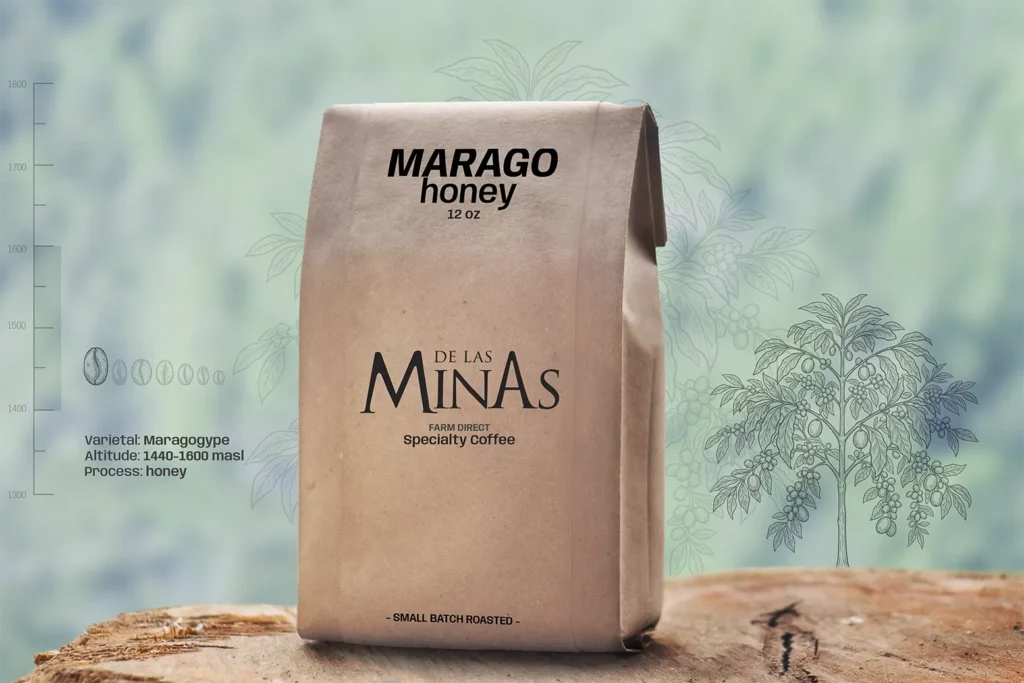
At Finca Peña Blanca, we recognize that world-class coffee often comes from laboratories or high-performance nurseries. But sometimes, the most exceptional coffees don’t come with a pedigree at all; they are the result of human connection. This is the story of our Maragogype, that we have come to appreciate so much, and the many people who helped us bring it to life.
Somewhere around 2013–2015, while working on our avocado fields, we found ourselves visiting and resting at the home of a local coffee producer named Don Julio. His hospitality towards us has always been warm, but it was his casual mention of a patch of coffee plants in his field that caught our attention. It was a patch of Maragogype—the “Elephant Bean”—a rare and demanding varietal that most farmers ignored because they didn’t produce the yields of standard commodity crops, but that locals kept for their household use.
Don Julio shared a handful of those seeds with us, and we planted them.
Our friend and exporter Cristy (Terra Negra Trade), and renowned coffee roaster, coffee buyer, and friend, Mike (former owner of Junior’s), visited us at the farm one day, and this is when things started to change. Mike stood alongside us when he held those enormous cherries in his hands. Mike remarked that most people never get the chance to see these cherries in person, as they are the kind of thing you only ever see in textbooks. That encounter sparked a transformation in our thinking. Without us asking, Arnoldo (Noldo, for short), our foreman at the time, overheard the conversation and took it upon himself to harvest all the remaining coffee cherries for seeds.
On our usual quality control visits to Ms. Silvia (Specialty Coffee Options), we took some Maragogype samples. She recognized the quality immediately and remarked to us, “This coffee is excellent, and it has the potential to be even better with the right dedication.” She gave us the crucial advice that changed our farm’s future: “If you are going to do this, stop planting them so tightly. Give them space.”
Taking her advice, we committed to a non-traditional “wide-spacing” strategy—planting every tree with three meters of breathing room between rows and one meter between plants. This approach was later confirmed by our long-time friend and coffee producer, Pancho, who comes from a family with generations of experience in coffee from Antigua. When he saw our fields, he encouraged us, confirming that this was indeed the right way to achieve the quality we were striving for. We traded yield for quality.
A little advice, a little luck
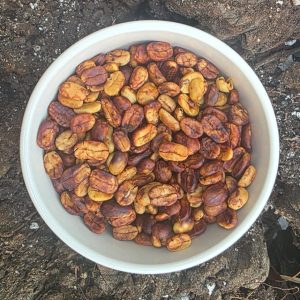
Now, the process of finding our “honey process” was an evolution and a little luck. Because the Maragogype beans were so large, they couldn’t pass through the standard screens of our wet mill and would instead exit through the kick-out shoot. We took those beans and leaned into the challenge. We came up with our version of a honey-processing method: skipping the mechanical washer entirely to preserve the mucilage.
We believe that the success of this method relied on our bunk-drying system. We built the bunks under a greenhouse, but it was our long-time friend and coffee producer Pancho who taught us how to use them. He moved us away from a haphazard approach, showing us exactly how to control the airflow and the drying cycles. We believe that learning his specific method for drying was a major part of the success of this coffee.
Later, we have been learning from our friend and client, Teco (Teco’s Coffee), an experience that has proved to be an eye-opener, providing us with deeper insights into the character and potential of our different coffee varieties, and helping us get to know our Maragogype better.
Update - 2024: On the right track
In 2024, we received confirmation that we were on the right track. We submitted a small washed Maragogype lot (small, but it was all we had!) to Anacafe to participate in an auction hosted by Anacafe and a Japanese buying company called UCC. There, we secured second place with a score of 87.51.
Update2026: Cup of Excellence 2026 - National Winners
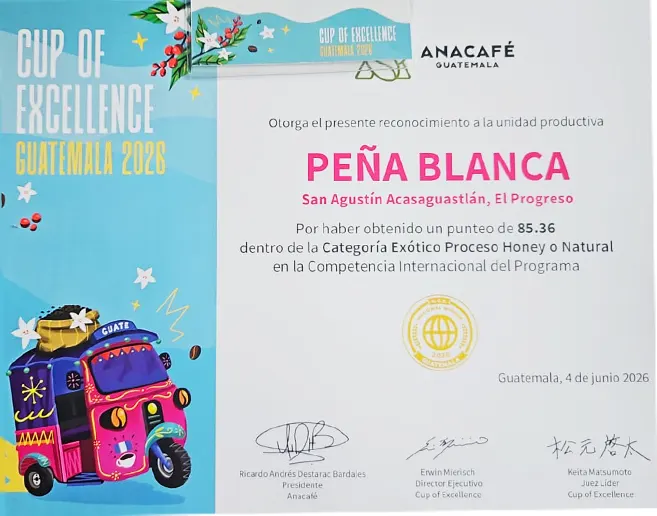
Building on all of those years of serendipitous encounters and eye openers, we decided to enter our Honey Maragogype into the 2026 Cup of Excellence. It was a high-pressure scramble; because our harvest runs later than most, we had to push hard to get our samples to Anacafé and the full lot to the dry mill in time. We managed to clear those hurdles, and we are proud to have been awarded one of the two National Winners spots in the Exotic Natural & Honey category. See the winners list by clicking here.
Maragogype - Technichal Details
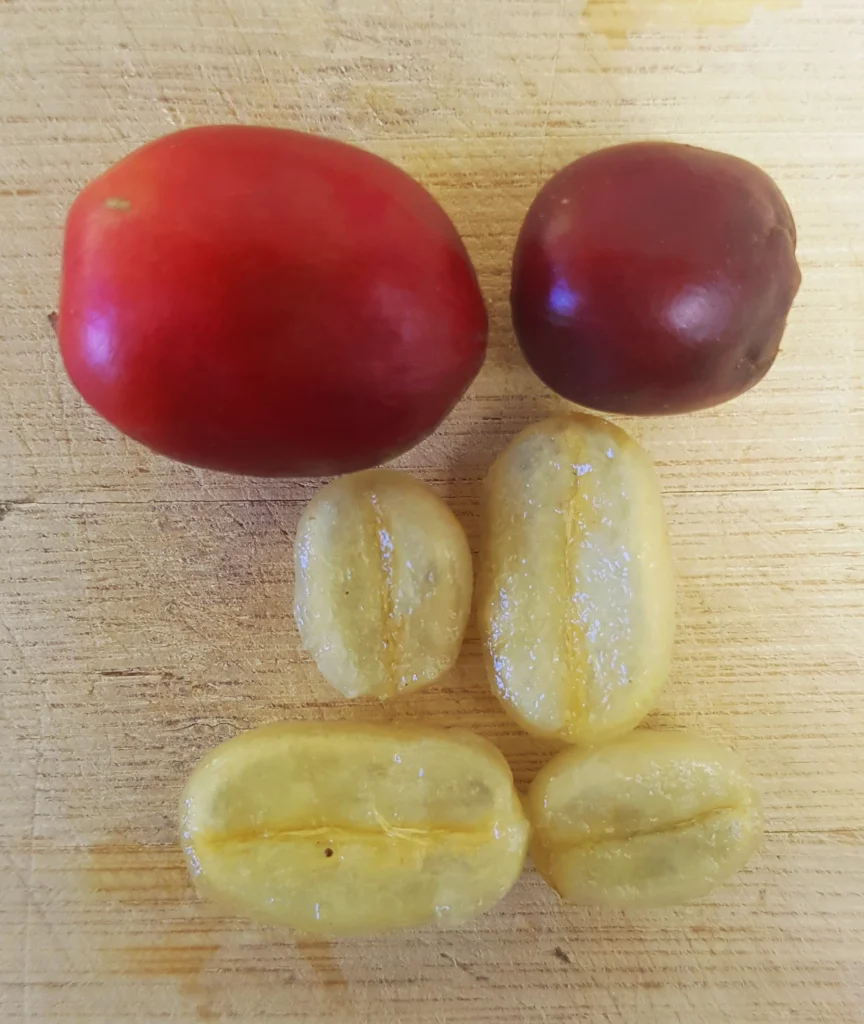
It is a spontaneous mutation of the Coffea arabica variety Typica. Because it is a mutation (and not a crossbreed), it retains the delicate, complex flavor profile of the classic Typica, but with unique physiological characteristics.
The variety is famous for its gigantism. Both the leaves and the seeds are significantly larger than standard Arabica varieties. This is caused by cells that are larger than normal (a phenomenon known as gigantism). While this gives the bean its legendary appearance, it also means the plant has a higher metabolic demand and a lower density of seeds per branch, which explains why yields are lower than modern varieties like Caturra or Catuaí.
Because Maragogype leaves are massive, they have a larger surface area that requires more sunlight and higher airflow to prevent moisture buildup (which encourages fungus).
By giving each tree 3 meters of space, you ensure that the lower branches—where the most significant production often occurs—get sufficient light to avoid premature leaf drop. This leads to better sugar development in the cherry.
Why honey? Maragogype’s larger seed structure and thinner skin (exocarp) mean that the ratio of mucilage to seed is often higher than in smaller beans. When we process it as “Honey,” we are utilizing that high mucilage ratio to facilitate a longer, more complex fermentation. By using the bunk-drying method, we are drying the bean slowly to prevent “case hardening” (where the outside dries too fast and traps moisture inside), which is a common failure point for giant beans.
Our Maragogype production
Because the Maragogype variety is so demanding and our wide-spacing strategy requires so much dedicated land, our production remains small and highly limited. We prioritize quality over volume, which means our annual harvest is often spoken for quickly. However, our production is growing, and we are committed to scaling our processes without ever compromising the integrity of the cup.
If you are interested in experiencing the Maragogype – The Elephant Bean- or learning more about our current harvest, we invite you to reach out directly. We would be honored to share what we have available from this harvest.